One Year Removed Sinners Still Strikes a Cord
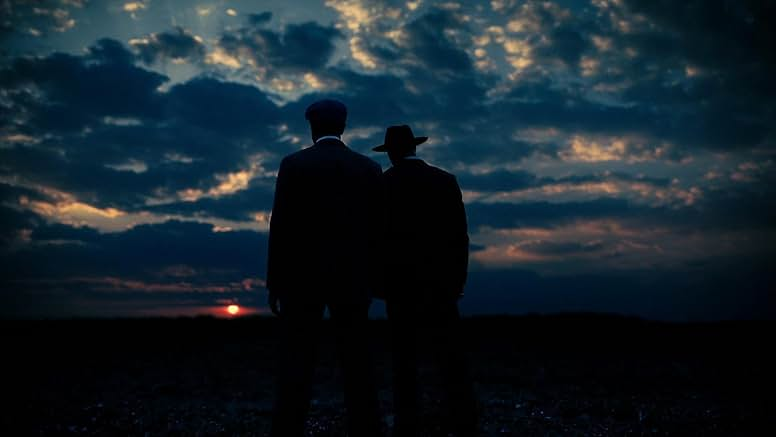
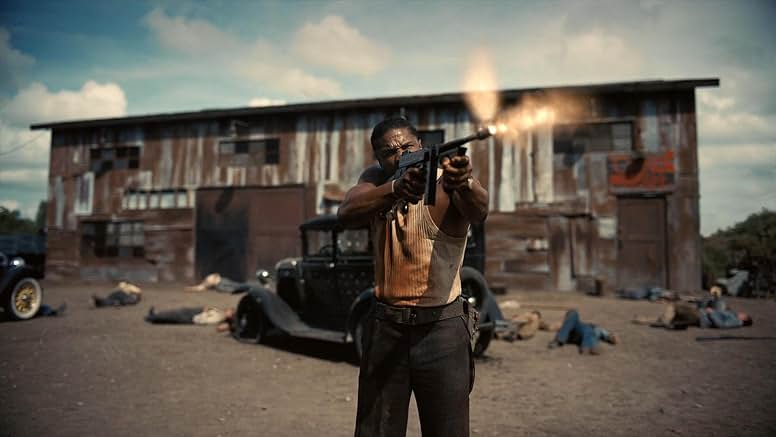
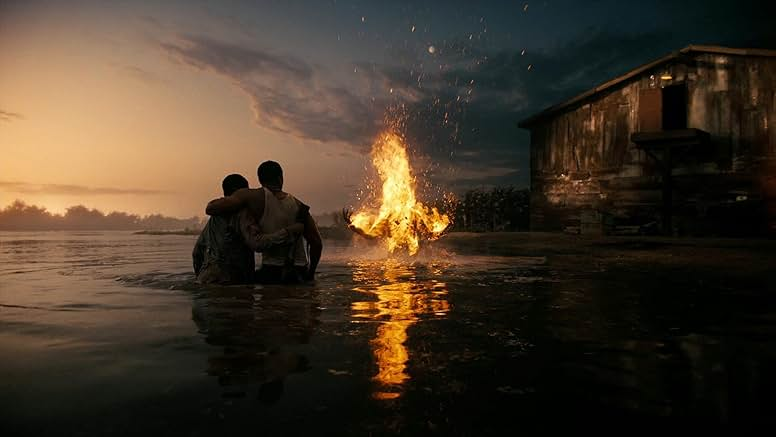
This weekend marks the one year anniversary of the film Sinners, a film that transformed the American film industry and flipped our modern interpretations of the post-antebellum South on its head.
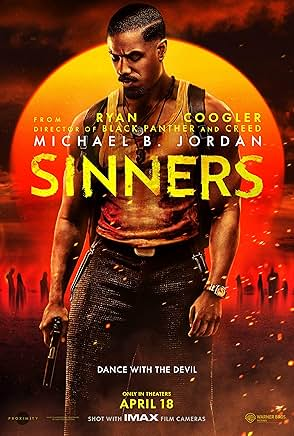
On multiple levels, Sinners is revolutionary — from the novel distribution deal writer-directer Ryan Coogler inked with Warner Brothers, to the groundbreaking production that earned Oscar nods in nearly every category from music to cinematography. On its face, Sinners seems to be a simple story of a family trying to reach an elusive dream, thwarted by mythical, evil forces. However the layers of story and performance are so intricate, the movie requires multiple watches to even attempt to capture its meanings. A year later, I feel I still may not do it justice.
It took me months to gather my thoughts surrounding this film. Each time I thought this piece was finished, I found I had more to add. Firstly, because the film is so broad in scope, but secondly because of all the cultural conversation around the film — both at the time of its release and months later ahead of the Oscars, where it became the most nominated film in history. I won’t attempt to address all of this conversation and controversy here (though I may do that elsewhere later), rather, I’m writing to share my thoughts on a movie that I believe will only continue to gain significance in decades to come, one that on its anniversary has already gained the status of classic.
Sinners is set in Jim Crow era Mississippi, in the 1930s. The selection of Mississippi as a setting establishes genre in two ways — first, it is a state with a history more horrific than most any horror film, and thus an appropriate setting for the genre, and second, it is the birthplace of the Blues, the music that sets the stage and character motivations for most of the film.
Personally, Mississippi holds significance. It is the place of my father’s birth, where generations before him worked Delta fields as sharecroppers, and before that, I imagine, as slaves. My family don’t talk much about Mississippi. I never once heard the word “sharecropper” but only understood that as our reality through context. I never heard my grandmother mention the place of her birth, or her past at all really. All the family lore I have, comes from my father and aunts.
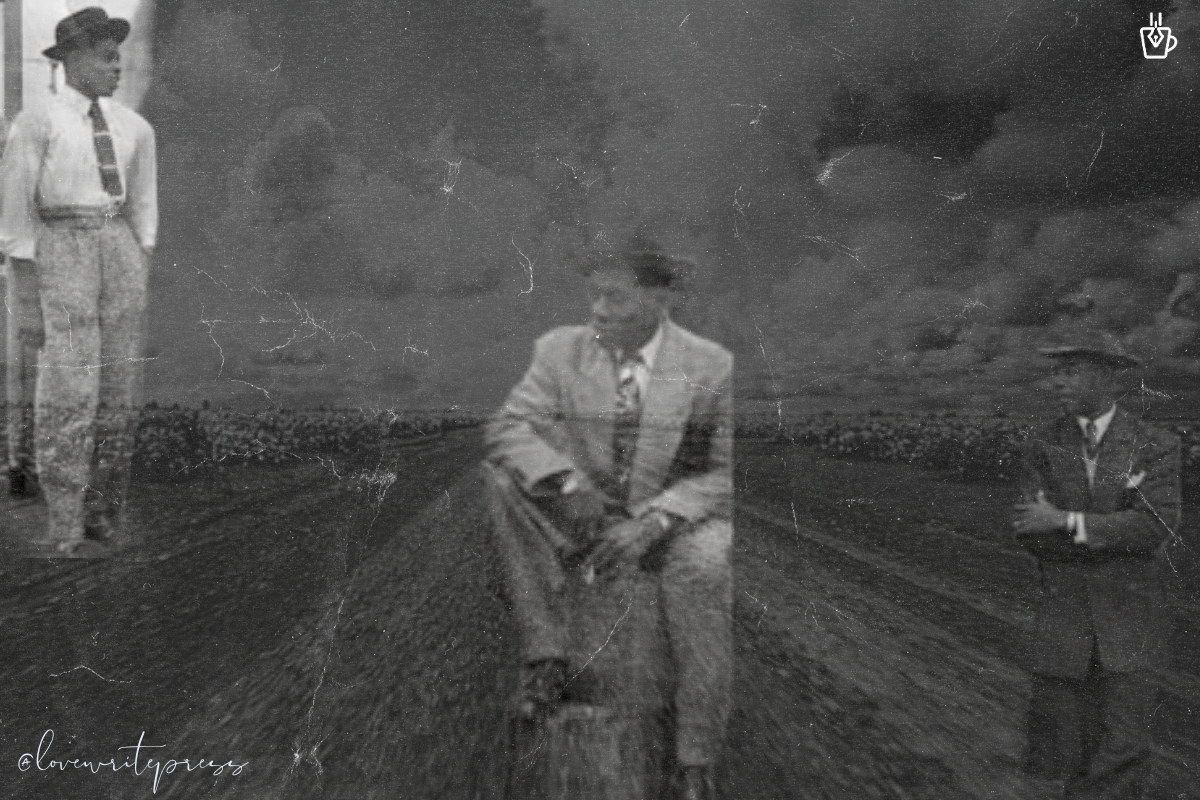
The impetus for my family leaving the south is likely the reason most of my grandmother’s generation didn’t speak much about it. They left Mississippi under threat of murder and landed in Chicago and Ohio, where my grandmother lived until she died. These places weren’t immune to racism — the opposite in fact — but they weren’t ruled by racial terrorists, which was a life-saving improvement.
The main characters of Sinners, Smoke and Stack, both played by Michael B. Jordan, could have been my great-uncles. Men who left the south and went north to Chicago to find economic opportunity and freedom. The main difference was my great-uncles, like so many of the Great Migration, never returned to the south, at least not permanently. The violence they fled was not the mythical or spiritual violence that Coogler invokes in the film, but a real and definite sort that Coogler uses as establishing fact and secondary conflict in the story.
Stack and Smoke’s return to the south is a heroic act akin to Icarus. They return home with bold ambitions, a concrete plan and daring confidence. Their return invokes a story arc that every Black American can sense before the sun even sets in the one-day storyline the movie employs. We know this story will end badly — that just in returning to this inherently violent place, in flaunting their wealth, good looks and big dreams, these characters will arouse a villain as old as America itself. They are flying too close to the sun — but it’s such a joy to watch.
Before Sinners I had never seen the Jim Crow south depicted from the perspective of a Black person who wasn’t actively being terrorized, who wasn’t running from it, but towards it. In Smoke and Stack, we get to see the potential of place. We get to see that the land isn’t inherently cursed or evil — that it is the work of people to make a place into what it is. Coogler uses the historic narrative of the Blues to show that Black people have already done exactly this — rewritten a place of horror into a sustaining symbol of possibility.
This potential is not only illustrated in Smoke and Stack’s dream to own a juke joint, but in the characters they draw into their ambition — their young cousin Sammie, with his wide-eyed innocence, Delta Slim, the tortured talent, Annie, the magical maven and Mary, for better or worse, the tragic mulatto. These characters feel new and rich in Coogler’s hands. It is a testament to his genius that we know this story is destined to end badly, just by merit of the genre, but that we are immediately enthralled by the exposition.
In fact, this is the very thing that makes this movie revolutionary. As descendants of the south, Black Americans know heartache and tragedy- of Mississippi specifically, we know Emmitt Till, Medgar Evers, and all the countless terrors, lynchings and injustices. But Coogler shows us the reverse of all those things. He shows us the talent, the spirit, the long-suffering beauty of our people, alighting the south in living color.
Coogler imbues his narrative with characters that illustrate the complex racial tapestry of America. Aside from the Black characters who are the central part of the story, we also see glimpses of the Asian American history in the south and the unspoken racial tradition of passing through Hailee Steinfeld’s character Mary. We even get to see the oppression and complexity in white America’s ethnic pool through the vampire character Remmick, played by Jack O’Connell, who subtly nods to Irelands colonial past.
Working through the vampirism metaphor, Coogler uses this tapestry of characters to demonstrate the false assurance of wealth, the complexity of solidarity, and the elusiveness of dreams.
Wealth is a guiding motivation for Stack and gives the illusion of protection for Smoke. However, money cannot save Smoke from his ultimate demise, making its assurance of safety and wellbeing false. Mary seeking out Remmick and the other vampires for their gold offering leads the entire cast to a night of horror. Most of the characters die because of this blind pursuit of easy money.
The characters of Bo, played by Thomas Pang, and Grace, played by Li Jun Li, demonstrate the complexity of solidarity. While they are necessary partners in creating the Juke Joint, providing valuable services throughout the day and night, their allyship is limited. When Bo becomes a vampire, Grace allows her personal grief to damn everyone remaining inside the Juke Joint to death.
The character Sammie, played by Miles Caton, represents the elusiveness of dreams. He longs to escape his life as a sharecropper and his restrictive role as the preacher’s son. He wants to play the music he wants and experience the excitement his cousins’ have lived. At Smoke and Stack’s Juke Joint, it seems his dreams will finally be realized. Instead, his voice alone serves as the inciting incident which brings the vampires into the plot. His promise and innocence are one of the things Stack and Smoke attempt to protect and ultimately, he is the character that makes it through the terror of the night and survives to see a future far different than Jim Crow. More than simply a character, Sammie is the living embodiment of his elder cousins’ dream — proof that dreams can often be more durable than life itself.
Like a master weaver Coogler creates a quilt as varied and natural as the ones so many southern mothers created, layering story over story and yet making it all feel like home. Then, as a perfect compliment, he sets the entire movie to music of the field, church and juke joint, the hymns that served as the birthplace of American music. As an extra homage, he names the main characters after one of the pioneering songs of the Blues genre, “Smokestack Lightning” by Howlin’ Wolf.
Floating over the entire story, the exposition and rising action, is the preview shown in the beginning of the film, introducing vampires as a threat. Almost immediately, you can see that vampirism is a metaphor for colonialism and Coogler sets up his metaphor masterfully. First, he uses Indigenous people, the first victims of American colonialism, to introduce the threat of vampires and warn others. Next, he demonstrates how colonialism recruits white people as acolytes, either through ignorance , fear or violence. From acolytes, they become the engine, moving the violent practice forward and recruiting others of all races. Lastly, like vampirism, colonialism seeks to consume, and yet is limited — it must be invited in.
The metaphor works as a warning against inviting outsiders into sacred spaces. But it also demonstrates how to resist and survive. Hauntingly through Stack it shows that one way to survive it is to become it.
The beauty of Sinners is that Smoke and Stack were always intended to die. The Icarus archetype requires that characters have grand ambitions and that they fail to adhere or respond to limitations, thus resulting in their death. Placing that trope at work in the Mississippi Delta is genius because it is so recognizable — every Black man has been Icarus at some point. Yet Coogler’s use of twins allows him to subvert the trope. Instead of the characters’ hubris resulting in one literal death, Coogler gives us two — a physical death and a spiritual one.

As suggested by its title, Sinners also does spiritual work. In the film, two characters exist at opposing ends of a Black spiritual spectrum: Annie, played by Wunmi Mosaku, and Jedidiah Moore, Sammie’s father, played by Saul Williams. Annie represents some of the African religions that transmuted into Hoodoo and Vodun traditions, while Jedidiah represents the Christian faith adopted by Black Americans due to American colonialism. In the film, we see both forms of religion used to combat the greater evil of vampirism. Though neither is completely effective, both have their place. Jedidiah’s words are a warning for Sammie and some could also interpret his prayers as a protective force which allowed Sammie to make it through the night. Annie’s hoodoo practice comes into play right as the characters realize that, like colonialism, vampirism is distinct from the forms of evil they are taught to immediately recognize. In fact, vampirism (read: colonialism) may even use religion as a tool, as shown when the vampire Remmick begins reciting the Lord’s Prayer alongside Sammie. Annie’s use of hoodoo as an effective weapon against vampirism brings to mind the words of Audre Lorde — “the master’s tools will never dismantle the master’s house.” Her practices are somewhat protective until the vampires are invited in.
Aside from illuminating the religious spectrum that often goes unacknowledged in Black communities, Sinners also uses the seven deadly sins to illustrate the arc of each character. Pride, said to be the root of all other sins, is the starting point for the story — the sin that both Smoke and Stack are guilty of.
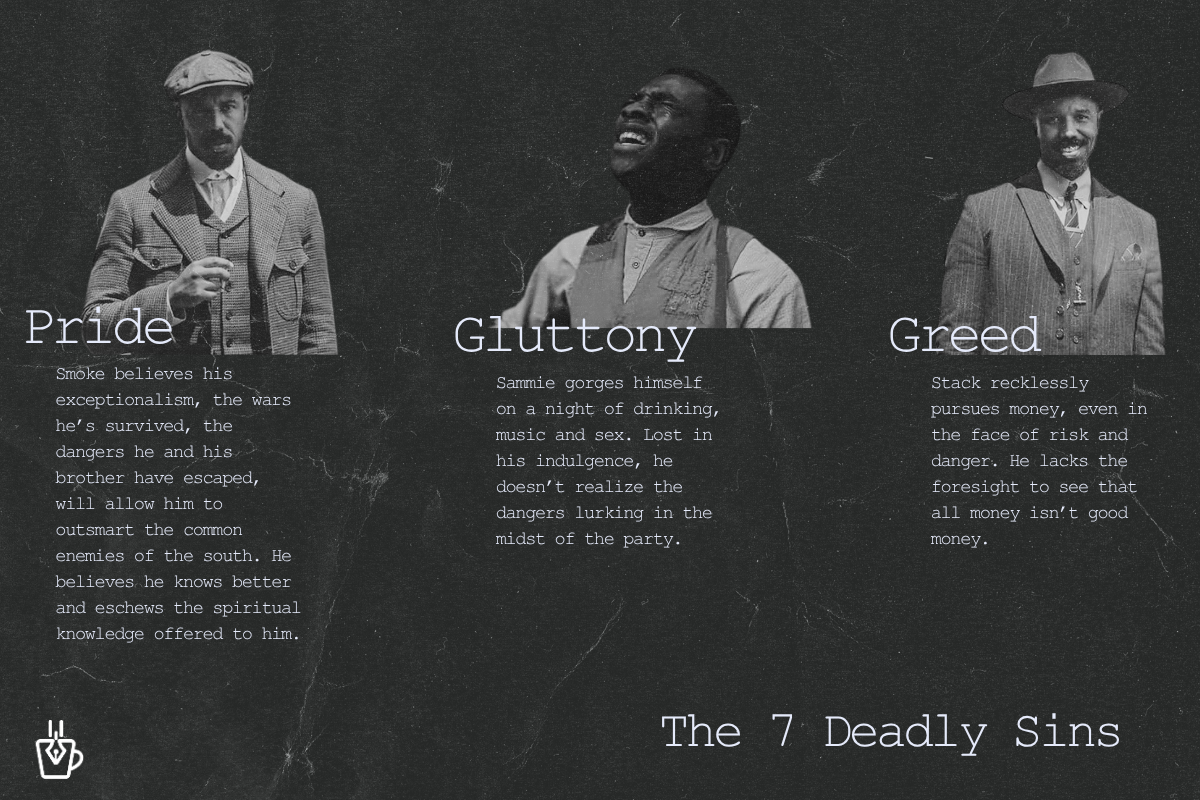
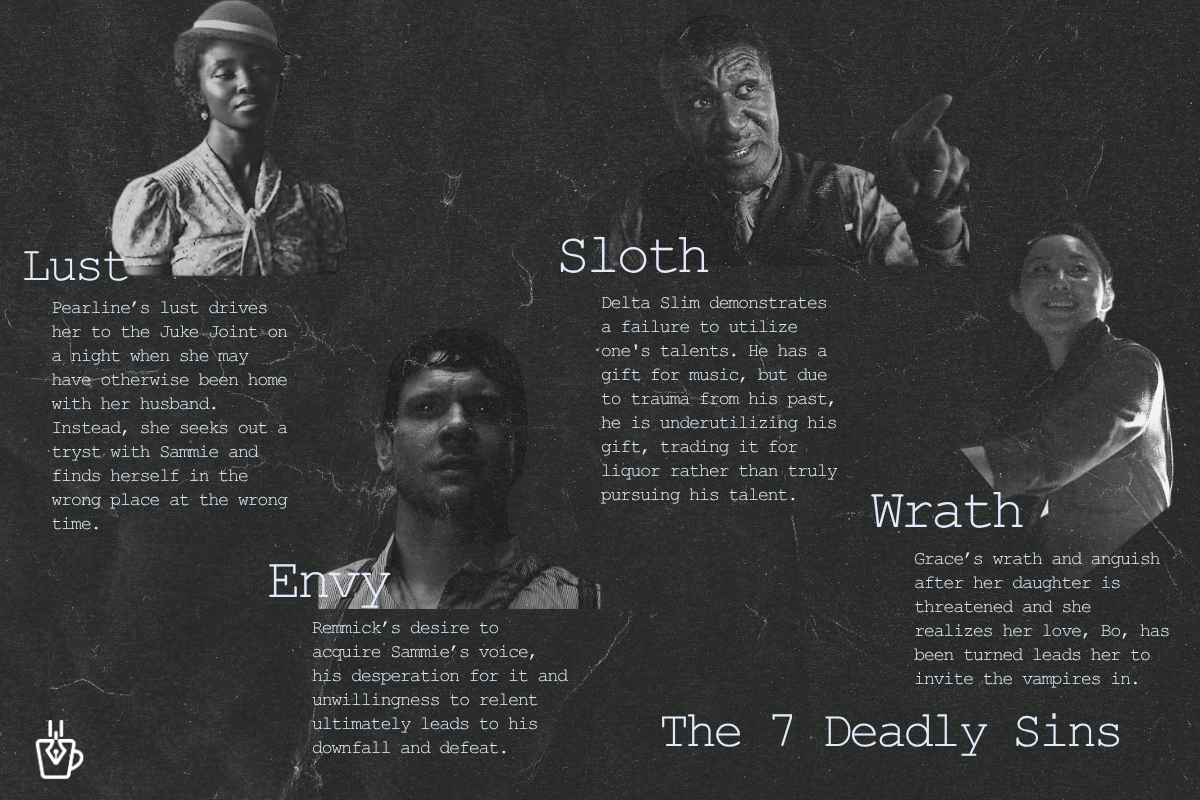
Throughout the course of the film we see pride, gluttony, greed, lust, envy, sloth and wrath demonstrated in the characters. After a night filled of sinful fun and deadly consequences, Sammie learns firsthand the wages of sin. He returns to the church and his father, guitar in hand, seeing the truth in his fathers words, but understanding the limitations in his ideology as well.
Sammie sees that there are truths universal across the Black religious spectrum, and yet none alone are adequate in combatting the evil of vampirism (read:colonialism). To defeat the evil, all aspects of community are needed, from the church to the juke joint and every layer of community in between.
One of the final things Sinners does, aside from utilizing common religious and mythic tropes to great effect, is it subverts some of the most common tropes in American film and literature, those originated during and as a tool of Jim Crow. The two that stand out most are that of the Mammy and the Tragic Mulatto.
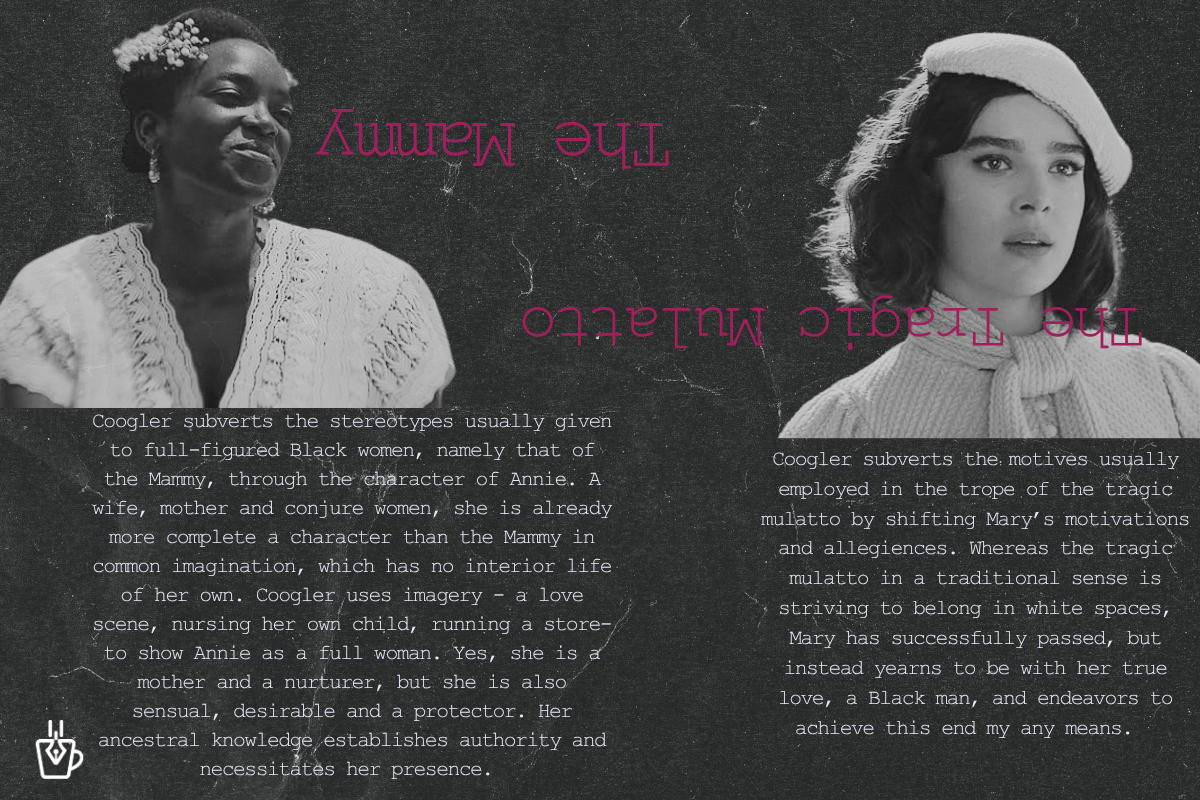
One of the most common tropes in American film, one that has been awarded time and again, is that of the Mammy. She is a figure that is recognizable in her maternal essence, but flat in her inner life and independent capacity. She exists to serve others, to be the supporting character. Though Coogler uses Annie in this way initially, introducing her as the supportive figure to Smoke, immediately we see a subversion happen, when we see their romantic chemistry and love scene.
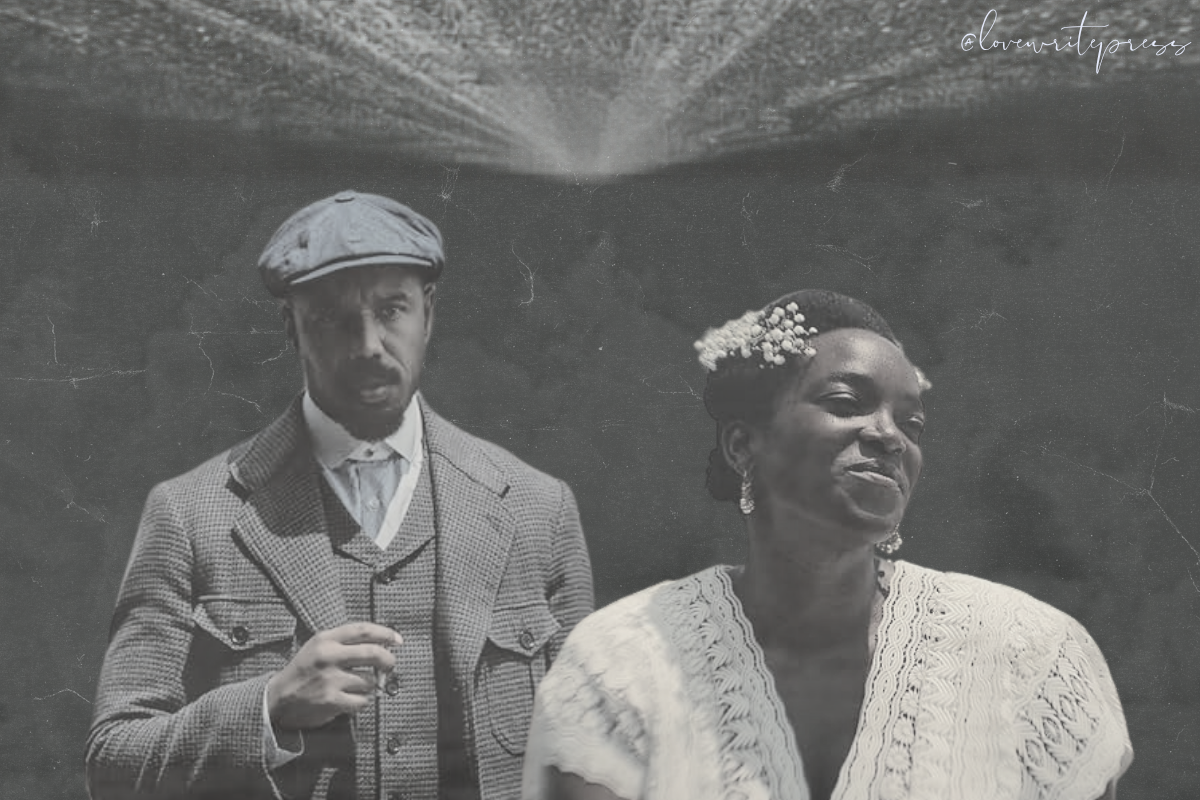
From that moment, Annie transforms from the flat caricature of Jim Crow imagining into a full woman — filled with love, grief, tragedy and, as we’ll later see, a bit of magic. She becomes a hero of the story, saving the lives of those in the Juke Joint momentarily with her ancestral knowledge, though her efforts are later thwarted.
With the second love interest of the film, Coogler interrogates another common stereotype: the tragic mulatto. In American lore, the mulatto character is often tragically trapped between two worlds and usually attempting, through passing or some other measure, to gain access to the white one. But Coogler shifts Mary’s allegiance, tying her romantically to Stack and allowing her to eschew her life as an accepted woman in white America and choose her own path, for better or worse.
There are entire books that could be written on Sinners and its many layers. The magic of the movie is not in the mysticism or vampires, but in the fullness of each character, in the fact that they feel so real. Sinners is not simply a horror film. Rather it is a story of possibility and resilience — a movie that show us all that our people built and that despite every atrocity, we managed to create enchantment.